
The grand strategy genre features one dominant name: Paradox Interactive. This developer created the newly released sci-fi hit Stellaris. They also produced the historical Europa Universalis series and the medieval Crusader Kings games. These titles established a massive, dedicated following.
They also create and publish the Hearts of Iron franchise. This series takes Paradox’s well-established grand strategy formula and slaps it into World War II. Paradox recently released the fourth game in the series. The studio put considerable effort into making this new title incredibly accessible. However, they successfully retained the immense strategic depth that veteran fans expect.
So what better time for a complete newcomer to try leading a nation to victory? As a relative Paradox beginner, I reached out to the company directly. I asked if they wanted a review from somebody completely unfamiliar with their mechanics. With my lack of experience, surely this would perfectly test the game’s new accessibility features.
If you want an in-depth breakdown of the changes since Hearts of Iron III, look elsewhere. Many awesome veteran players will tackle that specific subject with skill on the community forums.
Forging Your Nation’s Destiny
Hearts of Iron IV takes place from 1936 or 1939 onwards. The game puts you in direct control of a nation of your choosing. Players guide this country through the relatively gentle years before World War II erupts.
Setting Your Goals
This quiet period lets you begin constructing basic infrastructure. Leaders must develop their country and prepare for all-out war. You will form political alliances, draw up battle plans, and change national laws. Scientists will also undertake vital research to further your military capabilities.
With the historical focus option active, the AI attempts to follow real-world history accurately. Meanwhile, you possess the ultimate freedom to change history as you see fit.
Do you want to lead the Soviet Union on a global stampede? Players can do that easily. Do you want America to form an unholy alliance with Germany? Absolutely.
Seemingly, your primary goal involves ending the game with the highest score possible. But really, this acts as a massive sandbox game where you set your own goals. Gamers might try holding off the German offensive as Poland. Alternatively, commanders could lead China on a violent warpath. You simply pick an objective, fire up a campaign, and execute your strategy.
Logistics and Total War
The game demands intense focus on almost everything. Let’s examine a naval invasion of Japan, for example. First, you need to sort out the specific divisions for the assault. Therefore, generals must actively train their infantry troops. Marines work best for gaining a strong foothold when storming out of landing craft.
Supplying Your Army
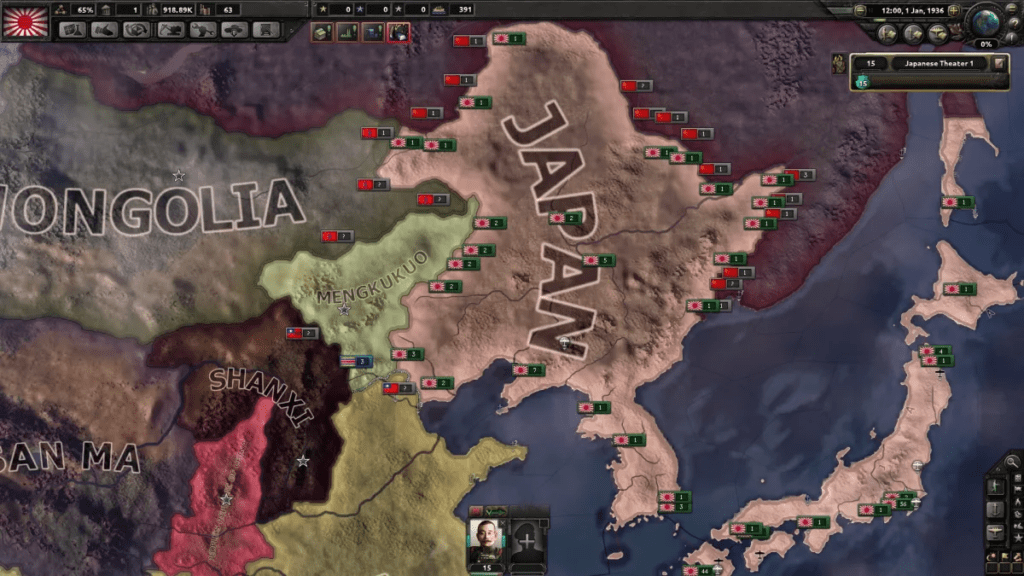
However, infantry divisions require proper equipment. Under the production tab, you must assign factories to craft weapons and support gear. Otherwise, commanders will deploy unarmed troops to the battlefield. This obviously reduces their combat abilities drastically.
Do you want your troops to take artillery, medical supplies, or anti-tank weapons? You will need to produce those items in massive quantities too. If generals send armored divisions on the invasion, they must construct reliable tanks. Training tank crews alongside regular infantry divisions heavily drains your manpower.
You must carefully consider exactly where you plan to land your troops. They will desperately need continuous reinforcements and fresh supplies. Therefore, invaders should always assault a major city or naval port first.
Without strong supply lines, your army will incur substantial combat penalties. The enemy force fighting in their own well-supplied territory will likely decimate your starving troops.
Securing the Seas and Skies
The fun does not end there. A naval invasion requires total naval superiority in every crossed sea sector. Thus, admirals must assign naval yards to build destroyers, submarines, and battleships.
Players must also consider crucial air support for the landing troops. Therefore, you need close support aircraft and nimble fighters to hold off the enemy airforce. You must allot even more factories to build these planes.
Fielding those aircraft requires a nearby frontline airfield. Invaders can capture an existing airfield from the enemy. Alternatively, you can begin work on massive aircraft carriers that sit off the coast.
Leaders have a lot to manage, but things get even more complicated. Chances are your nation will quickly wind up short on natural resources. Therefore, trading with other nations becomes absolutely vital. You must sacrifice some of your civilian factories and shipping convoys to secure trade deals.
Furthermore, navies must actively protect your valuable convoys. The enemy can attack them and cripple your military production capabilities instantly. Pumping out resources for one offensive could leave you struggling on another front.
Building the War Machine
Let’s get down to the nitty-gritty details of how this complex economy works. Firstly, players manage nation-building across three different structural levels.
Infrastructure and Civilian Industry
State structures include basic infrastructure, airfields, radar arrays, and anti-air guns. Infrastructure dictates the exact speed at which supplies and troops move around the map. Provincial buildings include land forts, naval forts, and coastal ports.
However, leaders will mostly focus on the available building slots in each region. Civilian factories remain the most basic and versatile structures. You must ensure you have enough of these to create consumer goods for your people. Your currently chosen economic law indicates this specific consumer demand.
As nations move closer to war, they must modify these laws to produce fewer consumer goods. You also use civilian factories when trading with other countries for raw resources. Leaders basically trade their production ability for whatever materials they need. Therefore, possessing a massive export capacity will make your nation much stronger. Workers also use civilian factories to construct essential military infrastructure.
Military Factories and Dockyards
Military factories actively pump out the many items needed to fuel a war. These items include infantry weapons, tanks, support equipment, fighter planes, and heavy artillery.
Inside the production tab, you specify how many factories will create your chosen equipment. Managers earn massive efficiency bonuses for maintaining long, uninterrupted production runs. Naval dockyards work exactly the same way, except they only build warships on the coast.
Research and Politics
The massive research screen features eleven incredibly detailed tabs. These cover infantry, land doctrine, planes, ships, navy doctrine, air doctrine, support companies, and construction.
Developing New Technology
Each tab offers a truly sizable selection of distinct technologies to choose from. Land doctrine, for example, contains four entirely separate research trees. However, generals can only choose to develop one specific path. These paths then split off further, giving players more specialized development options.
Planning out your initial strategy and goals remains absolutely paramount. Focusing your research efforts properly results in much more powerful armies. For instance, wasting time developing a strong navy makes no sense if you fight mostly in Russia. Infantry and airforce technologies remain key in those sprawling land battles.
Researching new technology heavily shapes the battlefield. It grants access to superior fighter planes, advanced support artillery, and hulking battleships.
Political Influence and Focus Trees
Meanwhile, the political front lets you shape your nation and its global relationships. Leaders use political influence to alter the fundamental laws of their country. You can enact harsher recruitment policies that drastically increase your available manpower. Rulers can also radically change their economic stance.
You can assign a variety of historical figures to roles within the government. Influence allows you to hire expert tank designers and seasoned military advisors. These figures provide excellent stat bonuses to a variety of areas.
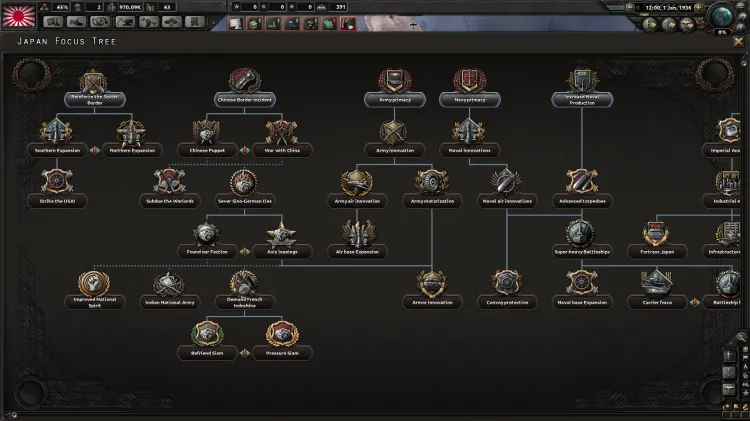
Then players have their national focus panel. This panel essentially acts as a collection of political, economic, and diplomatic research trees. Each of the seven major nations gets a completely unique national focus tree. Minor nations must settle for a generic selection.
If you play as Japan, you can research the Marco Polo Bridge Incident. This focus allows you to incite a massive war with your Chinese neighbors. America can issue lucrative war bonds if it meets certain requirements. These focuses all take 70 days of in-game time to research fully.
Command and Control
Commanders can attack the enemy simply by picking some divisions and clicking on a sector. However, the game really wants you to use its detailed planning tools for an authentic feel.
Drawing Battle Plans
First, generals must assign their divisions to a skilled commanding officer. Next, they establish a solid defense line where their troops will start. This usually represents a border with another country.
Planners can manually paint defensive lines to assign specific divisions to smaller areas. This lets you place your elite armored divisions in a specific area, ready to push forward. By clicking the offensive line command, you draw a line to your intended destination.
Executing the Attack
When you hit the execute button, your troops attempt to advance toward that specific goal. They capture enemy territory as they march forward. Generals can draw multiple offensive lines for a single army.
This allows players to create highly complex plans and execute highly specific attacks. Armies earn substantial stat bonuses for giving troops time to rest and get organized. Giving the plan time to develop properly also provides a massive tactical advantage. This heavily encourages players to plan out moves in advance rather than attacking impulsively.
Performance Issues and Bugs
AI Limitations
Paradox’s artificial intelligence possesses a reputation for being less than impressive. Sadly, that reputation holds completely true here.
The ability to plan out attacks in detail breaks down when allies join the mix. AI allies frequently just do their own unpredictable thing. Players possess absolutely no way of working directly with them to form effective joint plans.
Furthermore, enemy nations struggle massively to handle multiple fighting fronts. They also rarely put up much of a fight when contesting naval or air superiority.
Framerate Drops and Glitches
From a performance perspective, the game gets progressively worse as matches stretch on. Once the global war starts properly, the game engine struggles to keep up with everything. This severe performance degradation only gets worse over time.
My framerate dropped well below 20 frames per second when zooming in for a tactical view. Nothing I did seemed to remedy the horrible stuttering. Even panning across the map when fully zoomed out resulted in serious juddering.
I run an AMD FX-8350 processor. My computer does not have the most processing clout available. However, my PC easily beats the recommended system specifications. Such huge framerate drops remain completely unacceptable in a title that looks relatively simple.
I also encountered several highly annoying bugs. Divisions sometimes completely ignored my direct orders. Sometimes, they failed to assign themselves to my drawn battle plans. I occasionally hit the execute button, only for the entire army to sit there doing nothing.
When planning a naval invasion, the game often claimed divisions were still preparing. Yet, no amount of waiting ever fixed this frozen state. Naval invasion fleets would sometimes turn around in the ocean for no apparent reason.
The Verdict
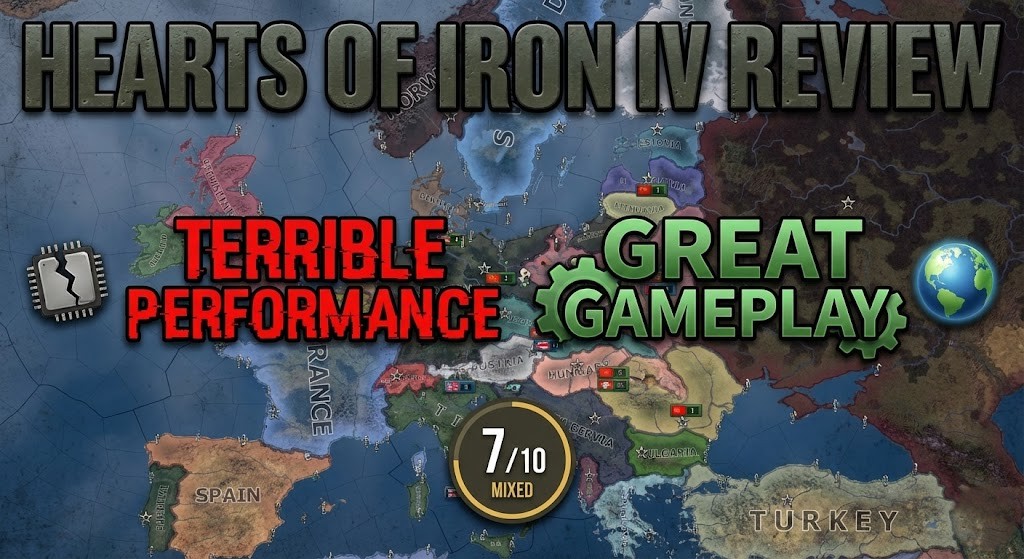
Paradox clearly tried hard to make their long-running franchise more accessible to new players. Despite their noble efforts, Hearts of Iron IV remains a very tricky title to grasp.
The complex controls and the dense interface take a long time to feel second-nature. Gamers must willingly devote considerable time to learning the game’s intricate mechanics. However, once controlling troops becomes natural, the immense depth of the gameplay finally shines.
Very few strategy games offer more complexity and depth than this series. This title strongly targets gamers who seek something that requires deep commitment. It heavily rewards that commitment with satisfying grand strategy gameplay.
Yet, I cannot stick a recommended sticker at the bottom of this review. The absolutely crappy technical performance holds the entire experience back. For now, buyers should only purchase it if they are hardcore strategy fanatics. Once developers release a patch to smooth out performance, this will become an easy recommendation.
Also Read : Tomba! Special Edition Review: A Quirky PS1 Classic Returns